
DeSoto, TX • Dallas County • Blog
How Fast Does Mold Grow on Wet Drywall in DeSoto, TX?
How fast does mold grow on wet drywall? Mold can start growing in 24 to 48 hours on wet drywall, according to U.S. EPA guidance. Drywall is paper-faced gypsum, and mold feeds on the paper. Once the board stays wet past two days, the risk climbs fast — and in a humid DeSoto, TX summer, it can start even sooner. The fix is speed: stop the water, dry the wall, and remove wet board. Call (469) 933-0245, 24/7.
You fixed the leak. The stain is dry. So why does the room still smell musty? Because mold does not wait for permission, and it does not need much time. On wet drywall, the clock starts the moment water touches the paper face. This guide explains how fast mold grows on wet drywall, why DeSoto homes are at extra risk in the summer, what to do in the first 48 hours, and how a proper drywall repair stops mold before it takes hold.
24/7 • DeSoto, TX 75115 & 75123 • By DeSoto Drywall Pros • November 6, 2026
The 24–48 Hour Rule
How Fast Does Mold Grow on Wet Drywall?
Mold can start growing on wet drywall in 24 to 48 hours. That is the guidance from the U.S. Environmental Protection Agency, which recommends drying water-damaged materials within 24 to 48 hours to prevent mold growth. It is not a deadline after which mold is guaranteed, and it is not a promise that drywall is safe for exactly two days. It is the window in which mold goes from possible to likely.
Three things have to be true for mold to grow: moisture, food, and time. Wet drywall supplies all three at once. The moisture is the water from the leak. The food is the paper facing on the drywall — mold feeds on paper, wood, and other organic material, and the paper face of a drywall sheet is an open buffet. The time is whatever passes while the wall stays wet. Mold spores are already everywhere, floating in the air in every home. They do not need to be brought in. They only need a wet surface to land on.
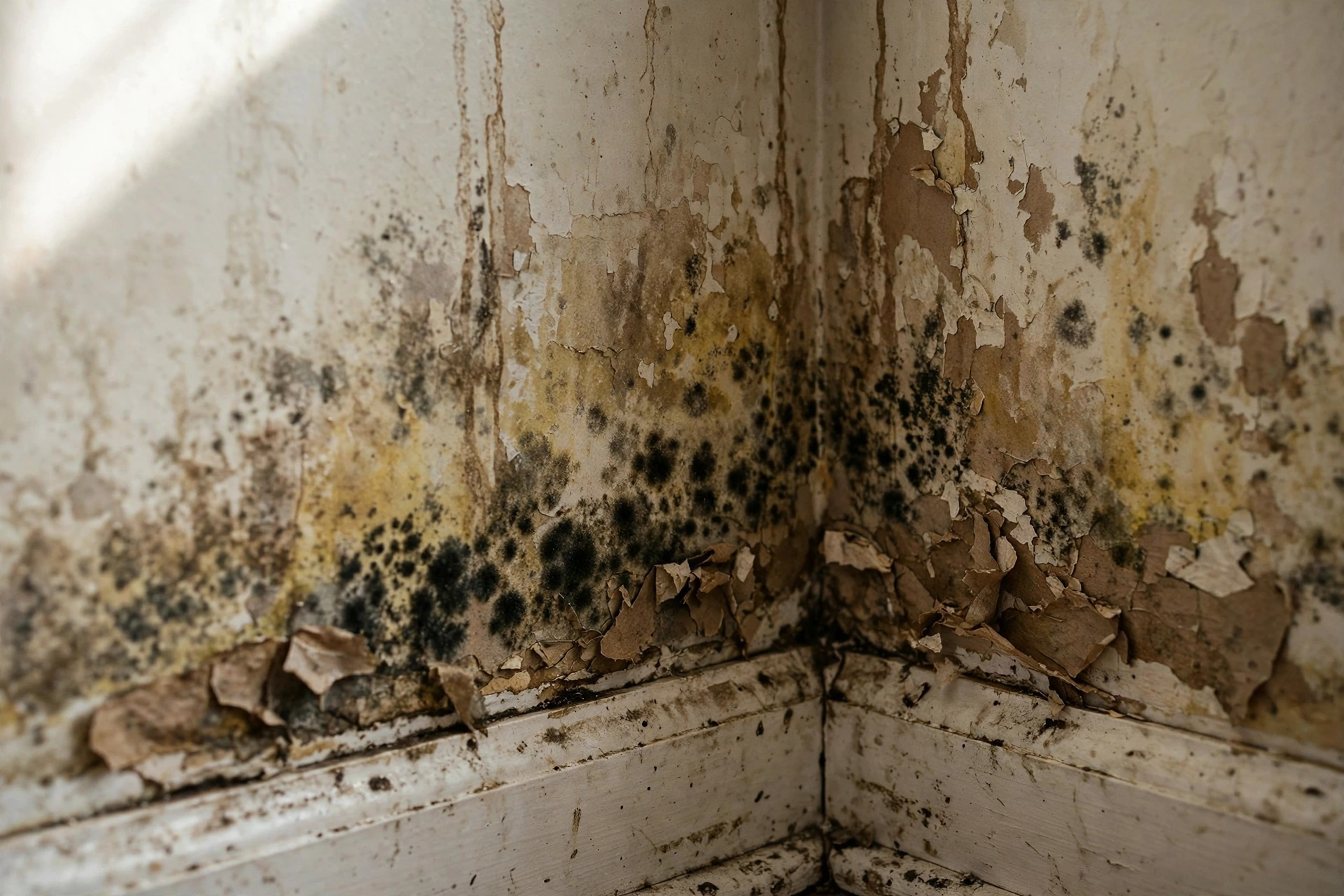
That is why the first 48 hours matter more than the next two weeks. Dry the wall inside that window and mold usually never gets started. Leave it wet past that window and mold is not a possibility any more — it is a question of how much, and where. The mold you can see is only part of it. Mold usually starts on the back of the board, inside the wall cavity, where it is dark, damp, and warm. By the time spots appear on the painted surface, the back of the board may already be covered.
One warning: the 24 to 48 hour window is a guide for clean water on a sound surface, not a guarantee. Dirty water — floodwater or sewage — changes the rules completely, and wet board from dirty water should come out regardless of how fast you act. And a wall that was wet, dried on the surface, and left damp inside the cavity can still grow mold days later. A dry surface does not mean a dry wall.
Why DeSoto Is at Risk
Why Mold Grows Faster in DeSoto, TX Homes
DeSoto is not a dry climate. Summers in southern Dallas County are hot and humid, and that humidity makes wet drywall dry slower — and mold grow faster.
First, humid air slows drying. A wet wall dries by giving its moisture to the air. When the air is already full of moisture, it takes less, and the wall stays wet longer. A wall that would dry in two days in a dry climate can take four or five in a DeSoto summer. That pushes the wall straight past the 24 to 48 hour window, even when the leak was fixed quickly.
Second, DeSoto homes are built for Texas heat, not for wet walls. Most homes here are one-story and split-level brick homes on slab foundations, with AC units in the attic or in a closet. When an AC drain line clogs in July — one of the most common leaks we see — the water drips slowly, for days, into a wall or ceiling that nobody opens. A slow leak is worse than a burst pipe for mold, because a burst pipe is obvious and gets fixed the same day, while a slow leak can wet a wall for a week before anyone notices a stain.
Third, the water often hides. In slab homes, a leak under a sink, behind a washing machine, or in an upstairs bathroom can wet the bottom of a wall and the insulation behind it while the painted surface still looks fine. The first sign is often a musty smell, not a stain. By the time you smell it, mold has already had days to grow inside the cavity. If a room in your DeSoto home smells musty and you cannot find the source, the source is probably inside a wall.
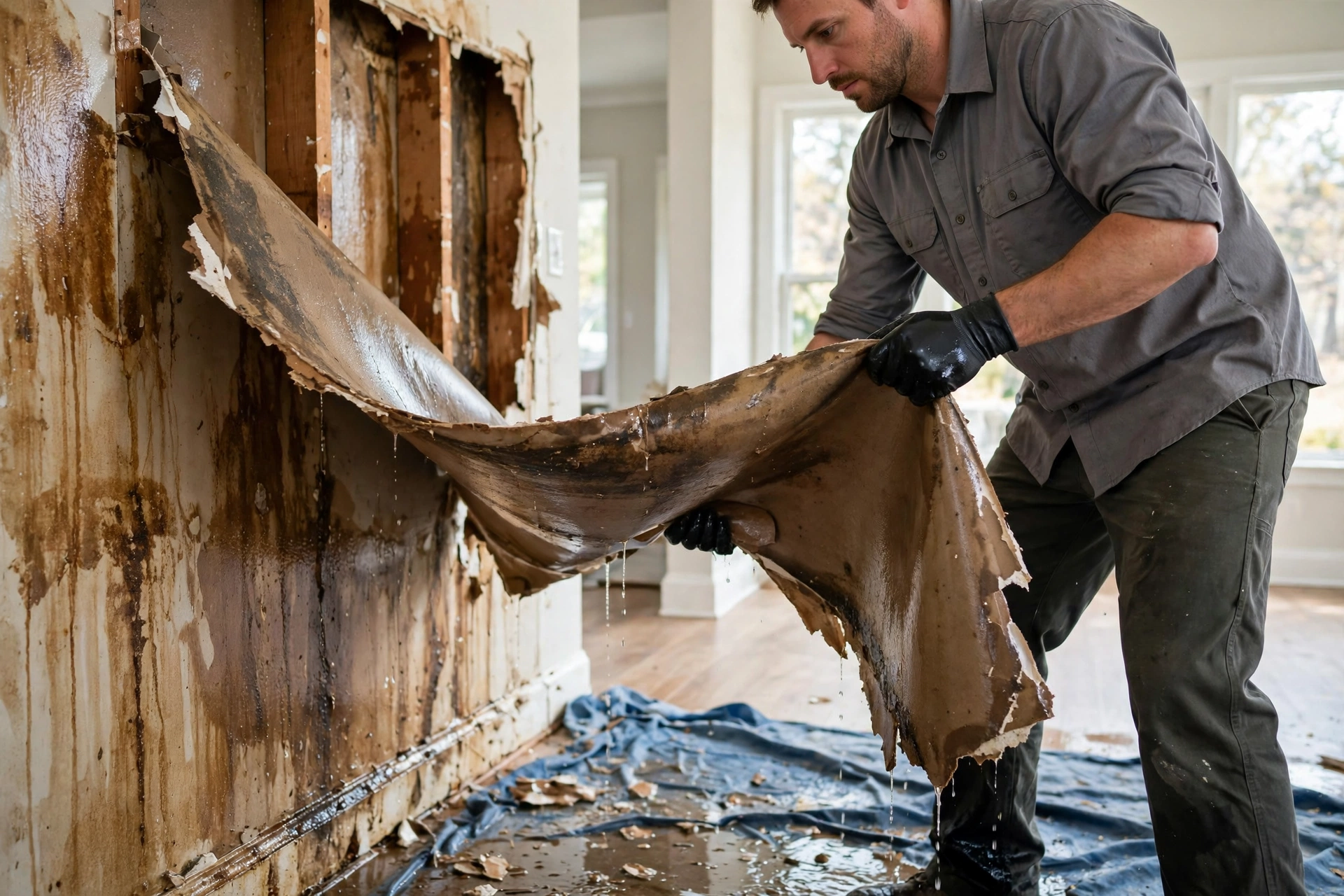
Mold usually starts on the back of the board, inside the wall cavity. By the time you see spots, the back may already be covered.
The Timeline
Mold Growth Timeline on Wet Drywall
| Time wet | What is happening | What to do |
|---|---|---|
| 0 – 24 hours | Spores land on the wet paper face and start to grow | Stop the water, start drying, call for help |
| 24 – 48 hours | Mold can start growing visibly; the risk climbs fast | Dry with air movers and a dehumidifier; check with a meter |
| 48 – 72 hours | Growth is likely on the back of the board and in the cavity | Wet board usually has to come out |
| After a week | Established growth, musty smell, possible spread to framing | Remove wet board and insulation, dry and treat the framing |
Use this table as a guide, not a promise. Temperature, humidity, and the type of water all change the speed. Warm, humid conditions speed mold up. Cool, dry, well-ventilated conditions slow it down. But no home in DeSoto in July is cool, dry, and well-ventilated inside a wall cavity. The safe rule is simple: treat every wet wall as if mold starts in 48 hours, because in a Texas summer, it often does.
First 48 Hours
What to Do in the First 48 Hours After a Leak
What you do in the first two days decides whether this is a drying job or a removal job. Work through these steps in order.
Stop the water
Shut off the water if it is a pipe, fix the roof leak, or clear the AC drain. Nothing dries while water is still coming in.
Call for help
Call (469) 933-0245. Tell us where the water came from and how long the wall has been wet. We answer 24/7.
Move air
Open windows if the outside air is dry, run fans, and run your AC. Air movement is what carries moisture out of the wall.
Do not paint over it
Paint traps moisture and hides mold. A stain that is painted over will bleed through, and the mold behind it keeps growing.
Do not use bleach on wet drywall and expect it to fix the problem. Bleach does not soak into porous gypsum, so it cannot reach the mold growing inside the board or on its back face, and it adds more moisture to a wall that is already too wet. Do not tear the wall open yourself either, unless you know what is behind it. Cutting into a wet wall without protection can spread mold spores through the house, and you may cut into wiring or a pipe. Leave the opening of a wet wall to a crew that bags the board out and keeps the dust down.
If the wall has been wet for more than 48 hours, assume the board needs to come out. Press it gently — if it feels soft, swollen, or crumbly, the gypsum has already lost its strength, and no amount of drying will bring it back. Our guide to how to tell if drywall is wet behind the wall explains the signs to look for, and our guide to how long drywall takes to dry after water damage explains what drying actually involves.
How We Stop Mold
How a Proper Drywall Repair Stops Mold
Stopping mold during a drywall repair is not a special product. It is a sequence: remove what is wet, dry what is left, and do not cover anything up until it reads dry.
First, the wet board comes out. Drywall that has been wet past 48 hours, or that is soft, swollen, or moldy, cannot be saved by drying. It is cut out, along with any wet insulation behind it, and bagged out of the house. Wet insulation holds water against the framing for days, so it comes out with the board. Second, the open cavity is dried with air movers and a dehumidifier, and we check the studs and the remaining board with a moisture meter. Drying usually takes 2 to 5 days, and we do not rebuild until the readings are dry. Third, the framing is treated to discourage regrowth, and then new drywall is hung, taped, mudded, textured to match, and primed paint-ready.
That is the full scope of what we do. We dry, remove wet board, and treat framing as part of a drywall repair. We do not claim to be licensed mold remediators, and we do not sell mold remediation. In Texas, mold assessment and mold remediation must be done by licensed professionals, and the same company cannot do both the assessment and the remediation on the same project. If we find mold growth that goes beyond a small area of wet drywall, we will tell you so and explain that a licensed mold professional is the right next step before we rebuild. Our mold prevention after water damage page explains exactly what is included in our work, and our drying and moisture detection page explains how we confirm a wall is truly dry.
For the official guidance behind the 24 to 48 hour rule, the U.S. EPA publishes a brief guide to mold, moisture, and your home, which explains when wet materials should be dried and when they should be thrown out. It is worth reading before you decide whether a wet wall can wait.
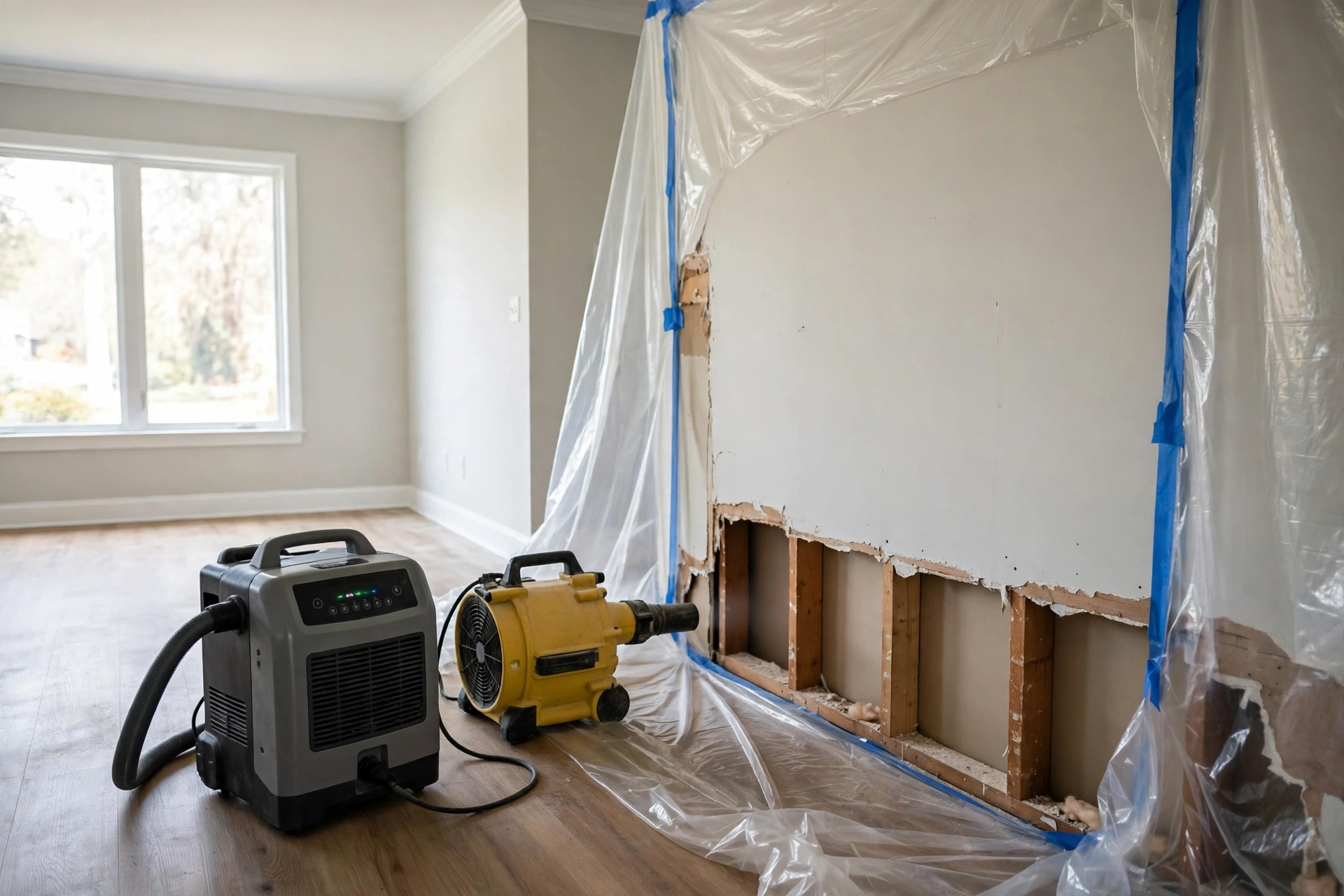
Drying with air movers and a dehumidifier, checked with a moisture meter, is what stops mold — not paint, and not bleach.
DeSoto, TX
Mold on Wet Drywall in DeSoto, TX Homes
DeSoto sits 12 miles south of Dallas, in southern Dallas County, on I-35E and I-20. The homes we work in most are brick homes built in the 1970s and 1980s, in neighborhoods including The Meadows, Thorntree, Eagle Crest, Brandonwood, Frost Farms, Amber Terrace, Hidden Lakes Estates, and Summit Parks, in ZIP codes 75115 and 75123. The leaks we see most are AC drain clogs in the summer, roof leaks after storms, upstairs bathroom leaks, and burst pipes in a winter freeze.
The AC drain clog deserves special attention, because it is the leak most likely to grow mold unnoticed. An AC unit makes gallons of condensation water on a hot July day, and all of it is supposed to drain away through a small pipe. When that pipe clogs with dust and algae, the water backs up and drips slowly into the wall or ceiling below, day after day, in the hottest and most humid weeks of the year. By the time a homeowner notices a stain or a smell, the wall has been wet for a week or more — far past the 48 hour window.
If your home smells musty, if a wall feels soft near the baseboard, or if a stain keeps coming back after you paint it, call (469) 933-0245. Tell us how long the wall has been wet and where the water came from. We will check it with a moisture meter, tell you honestly whether the board can be dried or needs to come out, and explain what happens next before we start. You can also read more about water damaged drywall repair in DeSoto, TX and the nearby cities we serve.
Related Services
Not sure which one you need? Call us at (469) 933-0245.
More From the Blog
Guides for DeSoto homeowners, written by DeSoto Drywall Pros.
FAQ
How Fast Does Mold Grow on Wet Drywall? Questions We Hear in DeSoto
How fast does mold grow on wet drywall?
Mold can start growing in 24 to 48 hours on wet drywall, according to U.S. EPA guidance. Drywall paper is food for mold, and spores are already in the air in every home. In a humid DeSoto summer, it can start even sooner.
Can wet drywall be dried before mold starts?
Yes, if drying starts within about 24 to 48 hours and the board is still firm. Air movers and a dehumidifier dry the wall and the cavity, and a moisture meter confirms it is dry. After 48 hours, or if the board is soft, it usually has to come out.
Does bleach kill mold on drywall?
No, not on wet drywall. Bleach does not soak into porous gypsum, so it cannot reach mold growing inside the board or on its back face, and it adds more moisture to an already wet wall. Wet, moldy board should be removed, not bleached.
Is mold on drywall dangerous?
Mold on drywall should be taken seriously, especially if it covers a large area or if anyone in the home has breathing problems or allergies. Small areas of wet board can be removed as part of a drywall repair. Larger growth needs a licensed mold professional in Texas.
How do I know if there is mold behind my drywall?
A musty smell that will not go away is the most common sign, along with a soft or swollen wall, bubbling paint, or a stain that keeps coming back. Mold usually starts on the back of the board, inside the cavity, so a moisture meter check is the way to confirm it. Call (469) 933-0245.
How Fast Does Mold Grow on Wet Drywall? Act in the First 48 Hours
How fast does mold grow on wet drywall? Faster than most homeowners expect — 24 to 48 hours. If your wall is wet, the time to act is now. Call DeSoto Drywall Pros at (469) 933-0245, 24/7 in DeSoto, TX. We will check the wall, dry it or cut out the wet board, and rebuild it right.
📞 Call (469) 933-0245 Now