
DeSoto Drywall Blog • November 6, 2026 • DeSoto Drywall Pros
How to Tell If Drywall Is Wet Behind the Wall in DeSoto, TX
How to tell if drywall is wet behind the wall? Check five signs: a brown or yellow stain, bubbling or peeling paint, a soft spot that gives when you press it, a musty smell that will not go away, and a dull thud when you knock on it. A moisture meter reading is what settles it for sure.
A wall can hide a leak for weeks. Drywall soaks water up like a sponge, paint holds its color for a while, and the framing stays out of sight. By the time a stain shows, the water behind it may have been running for days. The good news is that your eyes, hands, and nose can catch most of it early, if you know what to look for.
24/7 • DeSoto, TX 75115 & 75123 • About 25 km around DeSoto
The 5 Signs
How to Tell If Drywall Is Wet Behind the Wall: The 5 Signs
Check the five signs below in order, starting with the ones you can see. One sign on its own is a warning. Two or more together almost always mean there is water inside the wall, and the wall should be checked with a meter before anything is painted over.
Sign 1: A stain that grows
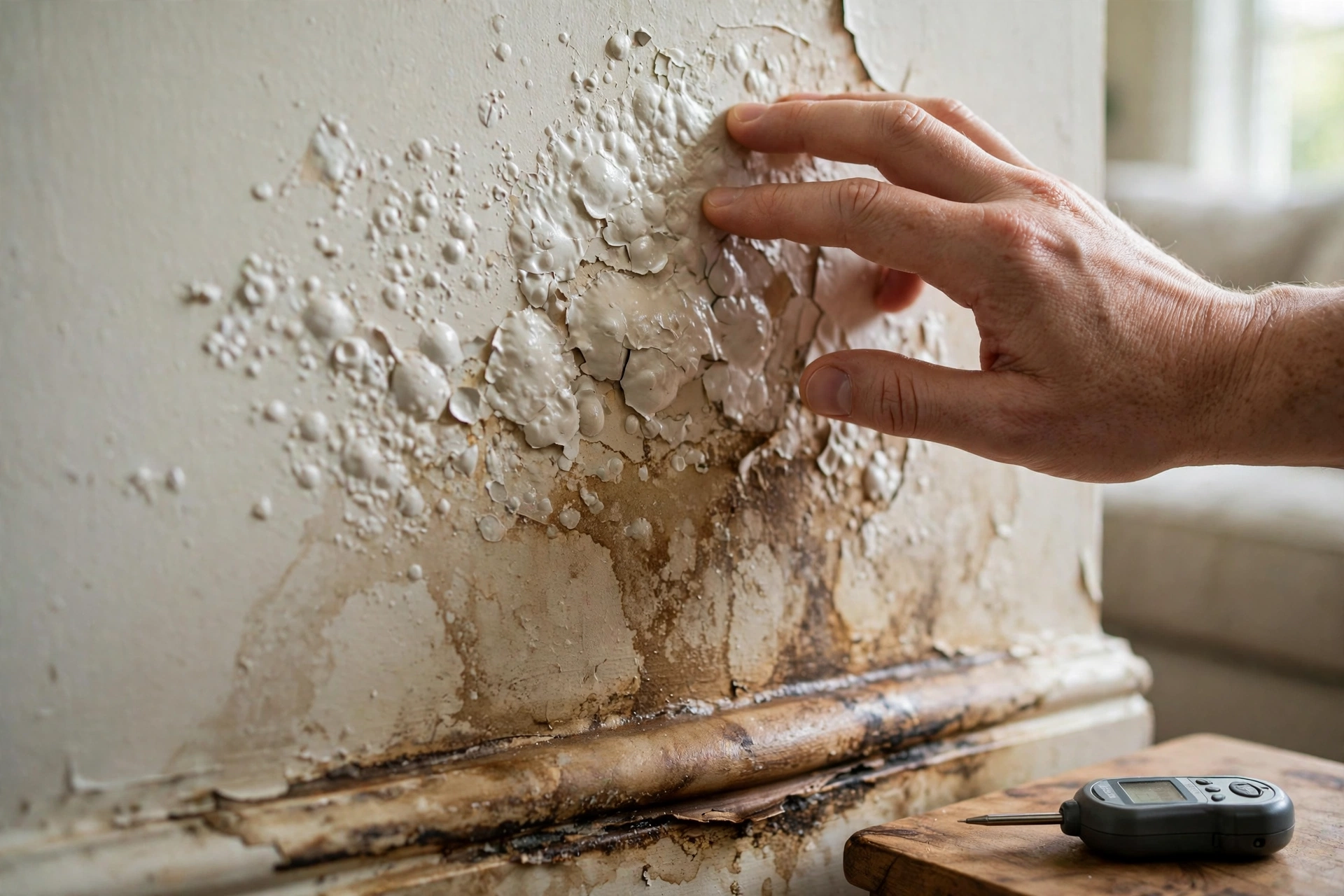
A water stain is usually yellow, brown, or copper colored, often with a darker ring around the edge. The ring is the tide line: it marks how far the water reached before it dried. A stain that dried and stopped growing may be old damage from a leak that has since been fixed. A stain that keeps spreading, or comes back after you paint over it, points to a leak that is still active.
Pay attention to where the stain sits. A stain low on the wall, near the baseboard, usually means water wicked up from the floor or from a leak at ground level. A stain high on the wall or on the ceiling usually means water came from above: a roof leak, an upstairs bathroom, or an AC drain in the attic. A stain on a wall that backs onto a bathroom, kitchen, or laundry room is the most common case of all, because that is where the pipes are.
Sign 2: Bubbling or peeling paint
When moisture builds up behind drywall, it pushes the paint off the surface. You will see bubbles, blisters, or flakes of paint lifting away, usually in one patch while the rest of the wall looks fine. That patchiness is the clue. Normal paint aging happens evenly across a wall. Bubbling in one spot means moisture is concentrated behind that spot.
The same thing happens to wallpaper. It lifts away from the wall, or the seams open up. Tape joints can lift too, showing as a straight line of bubbling along a seam. If you see tape lifting in a straight vertical or horizontal line, water has very likely reached the joint behind it.
Sign 3: A soft spot
Press the wall gently with your thumb near the stain or the bubbling paint, and then press a dry part of the same wall for comparison. Sound drywall resists. It feels hard and flat. Wet drywall gives under light pressure. It feels soft, spongy, or cool, and it may hold a faint thumbprint when you let go.
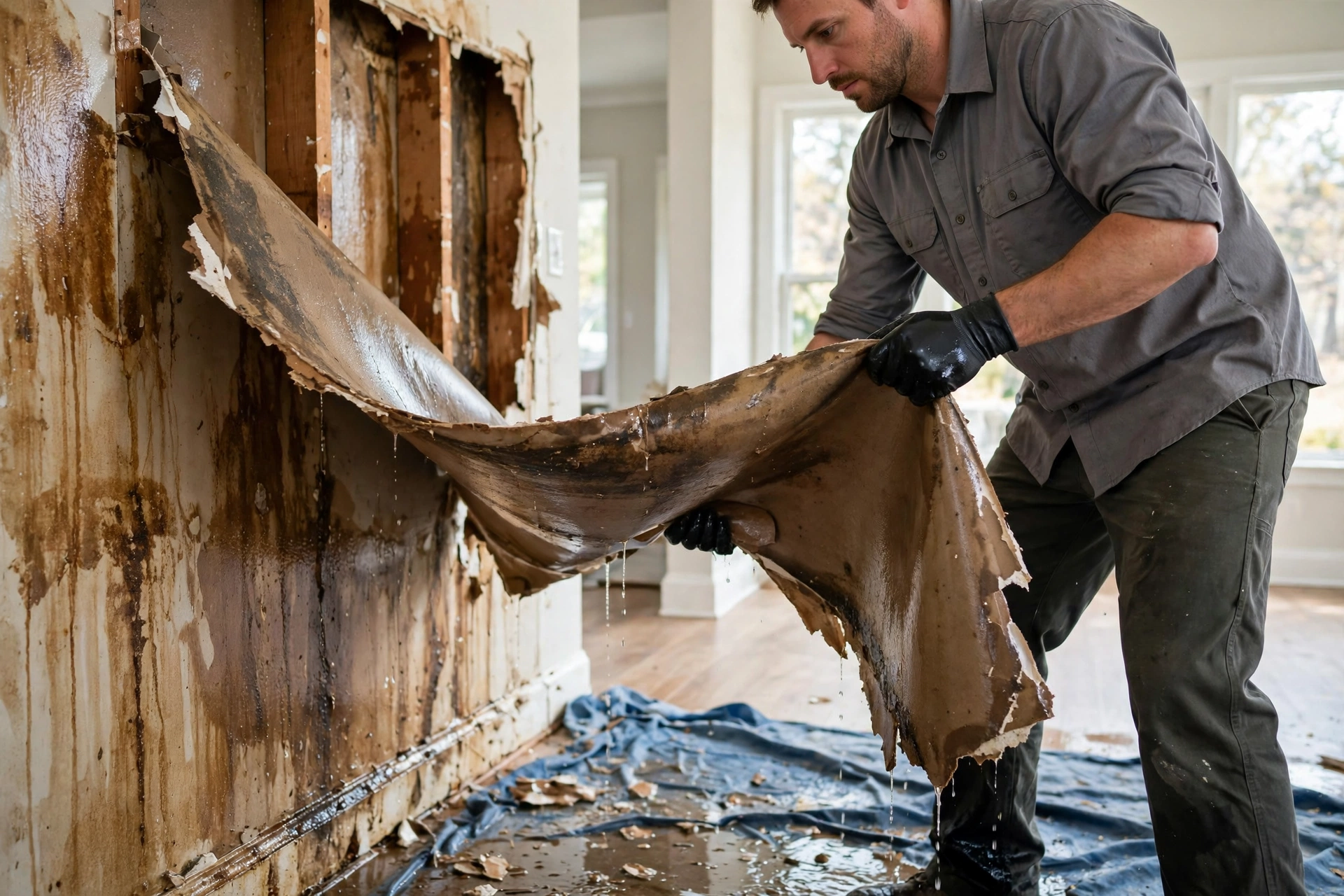
Check low on the wall first, near the baseboard, because water wicks upward and the bottom of the board gets wet first. Check around windows and doors too, and check the corners: corners are the first places wet gypsum breaks apart. Do not press hard. Severely water-damaged drywall can crumble or collapse, and a ceiling board that is soft should not be pressed at all. A sagging ceiling is an emergency, not a test. Keep everyone out from underneath it and call (469) 933-0245.
Sign 4: A musty smell that will not go away
Smell is often the earliest signal, and the one people dismiss most. Once drywall paper, framing, or the back of a cabinet stays damp, mold and bacteria can take hold on it, and that growth gives off an earthy, musty odor. It gets stronger in a closed room, after rain, or when the air handler kicks on and draws air from the wall cavity.
If a room smells damp days after the leak stopped, water is still inside the wall. Air freshener will not fix it, and neither will paint. The smell goes away only when the wet material is dried or removed. A smell with no visible stain is common, because mold usually starts on the back of the board, where you cannot see it.
Sign 5: A dull knock, and baseboards pulling away
Tap along the wall with your knuckle. Dry drywall gives a hollow knock. Wet drywall sounds duller, more like a thud, because the water has filled the tiny air spaces in the gypsum. Tap a dry section first so you know what hollow sounds like, then tap across the suspect area and listen for the change.
While you are there, look at the baseboards. When the lower part of a wall absorbs moisture, the drywall swells and the baseboards lose their grip or get pushed outward. Gaps between the baseboard and the wall, or baseboards that look swollen along one edge, often show up before the drywall itself looks damaged, because trim wicks moisture fast. Nails or screws popping out in a cluster is another sign in the same family: swelling framing and softened drywall have loosened the fasteners.
| Sign | What you notice | What it usually means |
|---|---|---|
| Stain | Yellow or brown mark, often with a ring | Water reached this far; growing means active leak |
| Bubbling paint | Blisters or flakes in one patch | Moisture pushing paint off the surface |
| Soft spot | Wall gives under light thumb pressure | Gypsum core is wet through |
| Musty smell | Earthy odor, stronger in a closed room | Mold growing on the back of the board |
| Dull knock | Thud instead of a hollow knock | Water inside the board or cavity |
The Test That Settles It
How to Tell If Drywall Is Wet Behind the Wall With a Moisture Meter
The five signs tell you where to look. A moisture meter tells you the truth. There are two kinds, and professionals use both. A pinless meter scans the surface without damage and gives a quick reading across a wide area, which is how we map how far the water spread. A pin meter pushes two small probes into the board and measures the moisture deeper inside, which is how we find out whether the cavity behind the board is wet too.
We compare readings from the suspect area against dry board in the same house. That comparison matters, because every house has a normal moisture level, and a number on its own means little without a dry baseline. The wall is wet when its readings are clearly higher than the dry board, and it is dry when the readings match and stay steady over two checks a day apart.
There is also a simple home test that helps when you have no meter: the foil test. Tape a square of aluminum foil over the suspect area and leave it for a day or two. If you find beads of water on the side of the foil facing the wall, the moisture came from inside the wall. If the water is on the room side, it is condensation. The foil test is useful, but it is slow and it only tells you that moisture is present, not how wet the wall is or how far it spread. It is a starting point, not a verdict.
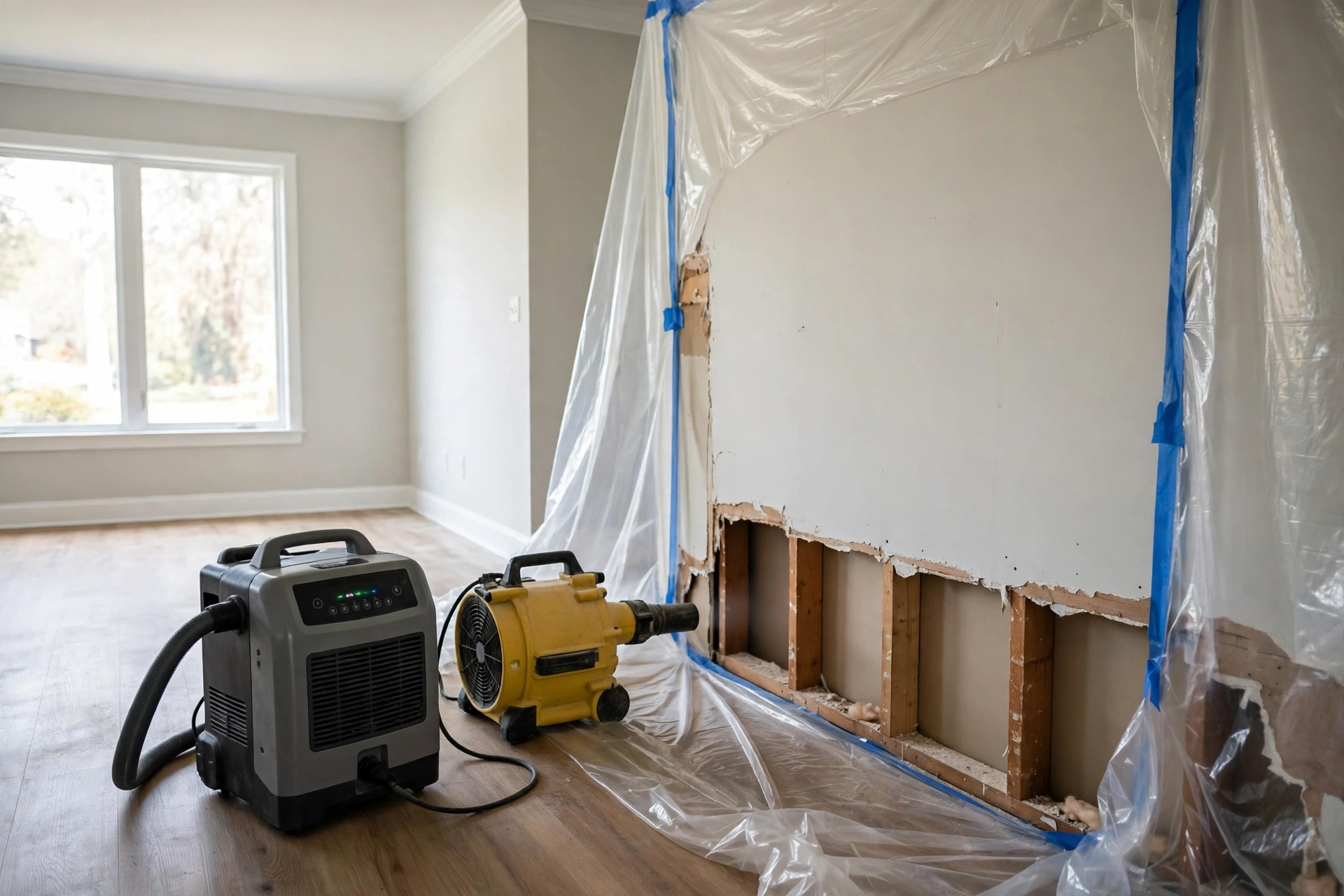
What you should not do is cut the wall open yourself to look inside. Behind that board are pipes, wires, and studs, and a cut in the wrong place can turn a small job into a big one. A meter and a thermal camera can find wet areas without cutting. If cutting is needed, we cut a clean line above the wet area, to the center of a stud, so the repair is simple and the new board has solid wood to screw into. Our drywall drying and moisture detection service follows exactly that order: measure first, open only what needs opening, dry until the readings hold steady, then rebuild.
What to Do Next
Your Drywall Is Wet Behind the Wall — What Now?
First, find the leak and stop it. Shut the water off if it is a pipe, and get the roof or the appliance fixed. Nothing dries while water is still coming in, and every day the wall stays wet moves the job one step closer to replacement. The U.S. Environmental Protection Agency advises drying water-damaged materials within 24 to 48 hours to help prevent mold growth, and that window starts when the water stops, not when you notice the stain.
Second, get a moisture reading. If the board is firm, the water was clean, and the readings show a small wet area, the wall can often be dried in place with air movers and a dehumidifier. That usually takes 2 to 5 days. Our guide on how long drywall takes to dry after water damage breaks down the drying time by how wet the board got.
Third, do not paint over it yet. Paint is the last step, not the first. A wet wall that gets painted traps moisture inside, and the stain bleeds through within weeks, the tape bubbles, or the musty smell comes back. Wait until the readings say the wall is dry, then seal the stain with a stain-blocking primer and paint. If the board is soft, sagging, or moldy, it should come out instead. Our guide on whether water damaged drywall can be saved explains the three checks that decide it.
Finally, keep photos and notes. Take a picture of the stain, the soft spot, and the baseboards before anything is repaired, and write down when you first noticed it and where you think the water came from. That record helps if you file an insurance claim, and it helps us find the leak faster when we arrive.
Think Your Wall Is Wet Inside?
Call us and describe what you see and smell. We will measure the wall, tell you how far the water went, and be honest about whether it can be dried or needs to come out.
📞 Call (469) 933-0245 NowDeSoto, TX
How to Tell If Drywall Is Wet Behind the Wall in DeSoto, TX
DeSoto sits 12 miles south of Dallas, in southern Dallas County, on I-35E and I-20. Most homes here are one-story and split-level brick homes built in the 1970s and 1980s, on slab foundations. In these homes, a leak has nowhere to go but sideways along the slab and up the wall. The bottom of the wall gets wet first, and the first sign is often a soft spot near the baseboard, a swollen baseboard, or a stain that keeps coming back after you paint it.
DeSoto summers make hidden moisture harder to catch. Hot, humid air keeps a wall damp longer, and a musty smell in a closed-up house in July is easy to blame on the weather. It is not always the weather. If one room smells damp while the rest of the house smells fine, check the walls in that room, especially the walls that back onto a bathroom, kitchen, or laundry room, and the walls under an upstairs bathroom or an AC unit in the attic.
We work across DeSoto, in ZIP codes 75115 and 75123, and in neighborhoods including The Meadows, Thorntree, Eagle Crest, Brandonwood, Frost Farms, Amber Terrace, Hidden Lakes Estates, and Summit Parks. The causes we see most are burst pipes, roof leaks after storms, AC drain leaks, and appliance hoses. For the full picture, see our water damaged drywall repair in DeSoto, TX page.
The 24 to 48 hour drying window in this article follows the U.S. Environmental Protection Agency guidance on mold and moisture in the home, which you can read at epa.gov.
FAQ
How to Tell If Drywall Is Wet Behind the Wall: Questions We Hear in DeSoto
How can you tell if drywall is wet behind the wall?
Look for stains, bubbling or peeling paint, soft spots, a musty smell, and a dull sound when you knock on the wall. Any one of these can mean water is inside the wall. A moisture meter reading is the only way to be sure, because it measures the board and the wall cavity, not just the surface.
Can drywall be wet with no visible stain?
Yes. A leak behind a wall can soak the back of the board and the insulation for days before anything shows on the painted surface. The first signs are often a musty smell, a soft spot low on the wall, or baseboards pulling away from the wall.
What does wet drywall feel like?
Wet drywall feels soft, spongy, or cool to the touch, and it may hold a faint thumbprint when you press it. Dry drywall feels hard and flat. Press a dry part of the same wall first, so you have something to compare it with.
How long can drywall stay wet before mold grows?
Mold can start growing on wet drywall within 24 to 48 hours, according to the U.S. Environmental Protection Agency. That is why a wall that has been wet for more than a day should be checked with a moisture meter and dried quickly, not just painted over.
Should I cut open the wall to check for water?
Do not cut a wall open yourself unless you know where the pipes and wires run. A moisture meter and a thermal camera can find wet areas without cutting. If cutting is needed, we cut a clean line above the wet area, to the center of a stud, so the repair is simple. Call (469) 933-0245 and we will check it for you.
How to tell if drywall is wet behind the wall in your home? Run the five checks in this guide, and if two or more point to water, get a moisture reading before you paint over anything. Call DeSoto Drywall Pros at (469) 933-0245 — we answer 24/7, we will measure the wall and tell you how far the water went, and if the board cannot be saved, we will cut out only what is wet and rebuild it paint-ready.