
DeSoto Drywall Blog • November 6, 2026 • DeSoto Drywall Pros
Can Water Damaged Drywall Be Saved in DeSoto, TX?
Can water damaged drywall be saved? Yes, sometimes. If the board stayed firm, the water was clean, and it dried within about 24 to 48 hours, it can usually be dried in place, sealed, and repainted. If the board is soft, sagging, moldy, or soaked by dirty water, it has to come out.
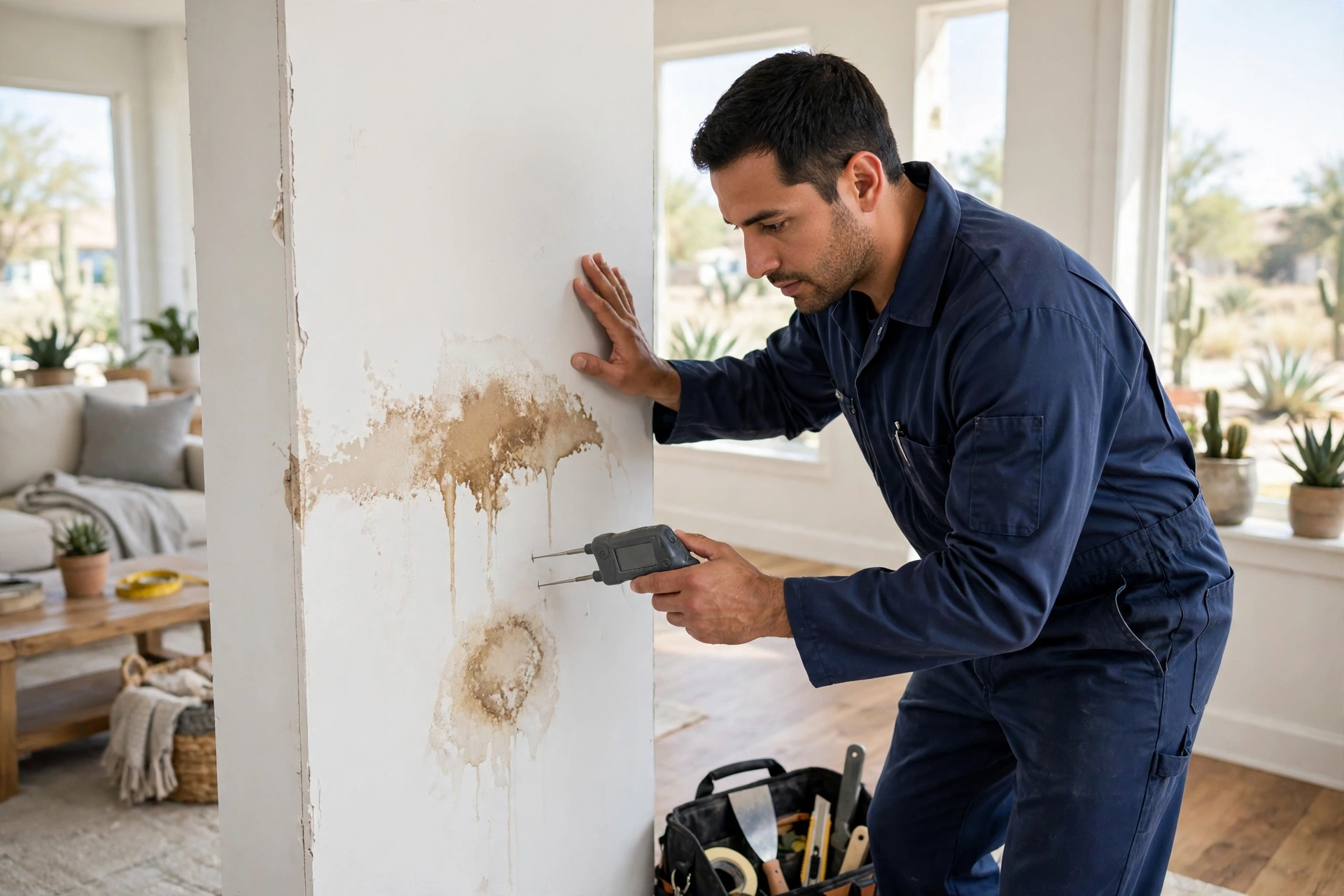
A brown stain on the wall is the question every DeSoto homeowner asks first: is this a quick fix, or does the wall have to be cut open? The honest answer is that it depends on three checks, and you can run the first two yourself in about a minute.
24/7 • DeSoto, TX 75115 & 75123 • About 25 km around DeSoto
The 3 Checks
Can Water Damaged Drywall Be Saved? The 3 Checks That Decide It
Drywall is gypsum with a paper face. It is strong when it is dry, but it soaks up water fast, and once the paper and the core get wet, the board starts to lose its strength. Whether it can be saved comes down to three things: how the board feels, what kind of water touched it, and how long it stayed wet. If all three point the right way, the board can usually stay. If any one of them points the wrong way, cutting it out is the safer call.
Run the checks in order. The first one takes ten seconds, and it already rules out about half of the wet walls we see.
Check 1: Is the board firm or soft?
Press the wall gently with your thumb near the stain, and then press a dry part of the same wall for comparison. Sound drywall resists. It feels hard and flat. Wet drywall gives under light pressure. It feels soft, spongy, or cool to the touch, and it may hold a faint thumbprint when you let go.
Soft means the gypsum core has already broken down. No amount of drying puts strength back into it. A soft board will not hold a screw, will not hold tape, and will keep crumbling under paint. If it is soft, the answer is replacement. If it is firm, move on to check two.
Also look at the shape of the wall. A board that is still flat can often be saved. A board that is swollen, bowed, or sagging has taken in too much water, and the paper face has started to separate from the core. Ceilings are the strictest case here: a sagging ceiling board is holding water above it, and it should be treated as an emergency. Keep everyone out from underneath it and call (469) 933-0245 right away.
Check 2: Was the water clean or dirty?
Water is sorted into three categories, and the category often decides the job. Clean water comes from a supply line, a fridge line, or rain through a roof leak. It carries no sewage and no flood mud. Drywall that only met clean water has the best chance of being saved.
Gray water comes from a washing machine, a dishwasher, or a shower drain. It carries soap, grease, and bacteria. Drywall soaked by gray water is usually cut out, because the porous gypsum holds onto contaminants that drying cannot remove.
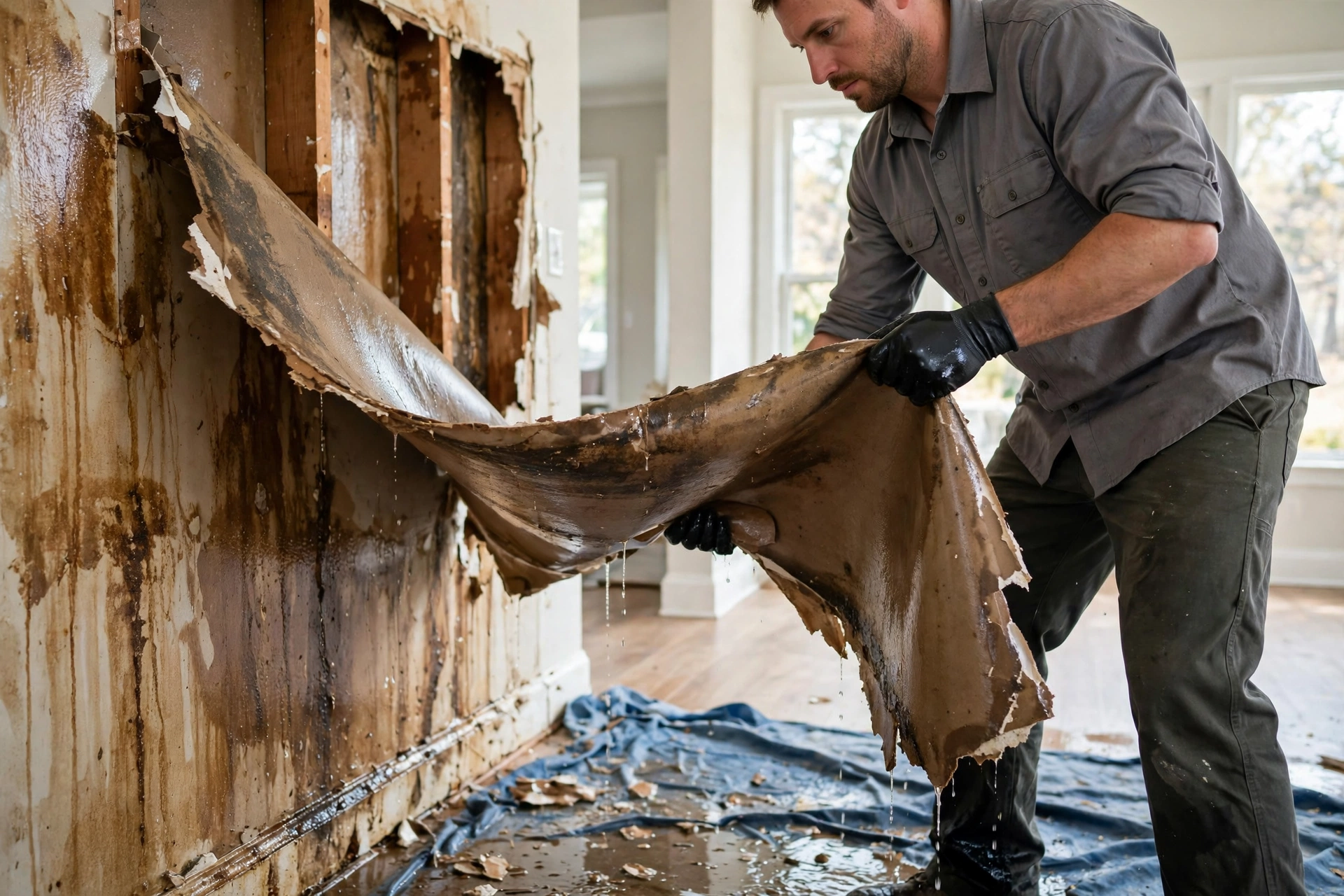
Black water is sewage, a toilet overflow, or floodwater from outside. Drywall touched by black water always comes out, full stop. It cannot be cleaned, and it should not be dried and kept. The same goes for any board with visible mold growing on it: moldy board comes out, and the wall behind it gets dried and treated before new board goes in.
Check 3: How long did it stay wet?
Time is the third check, and it is the one people underestimate most. The U.S. Environmental Protection Agency advises drying water-damaged materials within 24 to 48 hours to help prevent mold growth. That is not a hard deadline after which every wall must be torn out, but it is the window in which saving the board is realistic. Past that window, mold risk climbs, the gypsum keeps softening, and the odds shift toward replacement.
Think about when the leak started, not when you noticed the stain. A stain shows up days after the water started moving inside the wall. If a pipe has been dripping behind a bathroom wall for a week, the board has been wet for a week, even if you only saw the stain this morning. If you are not sure when it started, a moisture meter reading tells the truth: we measure the board and the wall behind it, and compare both against dry board in the same house.
| The 3 checks | Usually saved | Usually replaced |
|---|---|---|
| Feel of the board | Firm, flat, hard to the touch | Soft, spongy, swollen, sagging |
| Type of water | Clean water (supply line, rain) | Gray or black water (drains, sewage, flood) |
| Time wet | Under 24 to 48 hours | Several days, or unknown |
| Mold | None visible, no musty smell | Visible mold or strong musty smell |
When It Can Stay
When Water Damaged Drywall Can Be Saved
The best case is a small, clean-water leak that was caught fast. A supply line drip under a sink, a one-time roof leak over a ceiling stain, a short splash from an overflowing tub: the board gets damp, the leak is fixed the same day, and the board still feels firm. That board can almost always be saved.
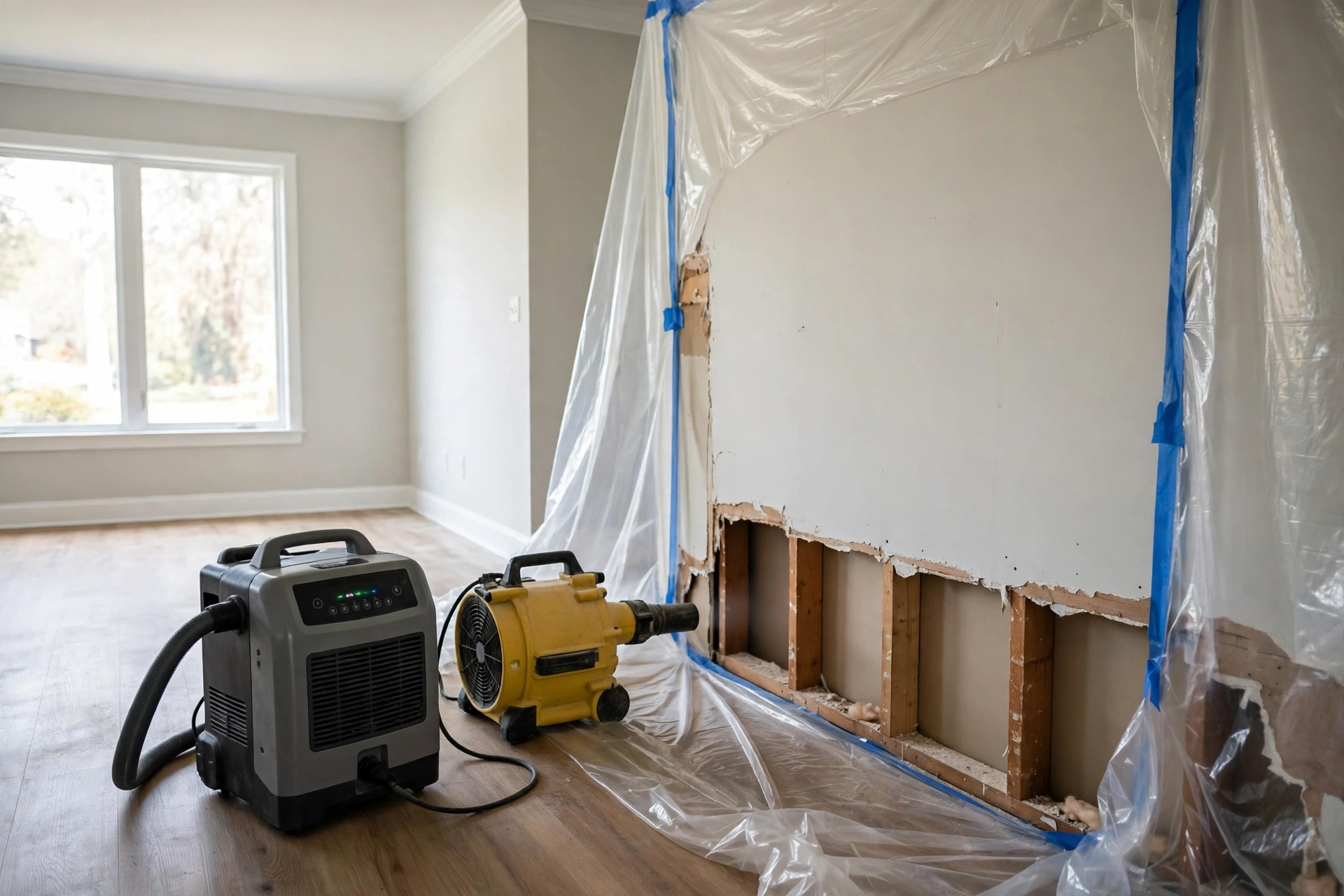
Saving it is not the same as ignoring it. The board still has to be dried properly, and that takes more than opening a window. Air movers and a dehumidifier run for 2 to 5 days, and the moisture is checked with a meter until the readings match dry board elsewhere in the house. Only then does the repair start: the stain gets a stain-blocking primer, because ordinary paint will not hold a water stain back, and then the wall is painted. Skipping the primer is the most common mistake we see. The stain bleeds through within weeks, and the homeowner ends up repainting a wall that was never really fixed.
One more thing to check before you save a board: the wall behind it. Drywall is only the face. If the insulation behind it is wet, it holds water against the back of the board and against the studs long after the surface feels dry. Wet insulation comes out even when the board stays. That is why a meter reading on the surface alone is not enough. The reading has to be taken inside the wall cavity, and the cavity has to test dry before anything is closed up.
If you want the full picture on drying times, read our guide on how long drywall takes to dry after water damage. It breaks down drying time by how wet the board got, and explains why a surface that looks dry can still be wet inside.
When It Has to Go
When Water Damaged Drywall Has to Come Out
Replacement is the right call whenever the board has lost its strength. That means soft or crumbling board, board that sags or bows, board with mold on it, and board that met sewage or floodwater. It also means board that stayed wet for days, even if it still feels firm, because the risk inside the wall is higher than the surface suggests.
Coming out does not mean the whole wall comes out. In most jobs we remove only the wet part, plus a safe margin above it. Drywall wicks water upward like a sponge, so the wet line inside the wall sits higher than the stain on the surface. We cut above the highest wet reading, to the center of a stud, so the new board has solid wood to screw into. That is usually a strip along the bottom of the wall, not the whole wall. Our wet drywall removal page walks through the process step by step.
After the wet board is out, the cavity gets dried with air movers and a dehumidifier until it reads dry on a meter. Only then do we hang new board, tape and mud the seams, sand them smooth, match the texture, and prime the repair paint-ready. A repair done in this order lasts. A repair that skips the drying step fails within months, usually as a stain that comes back, a seam that cracks, or a musty smell that will not go away.
Not Sure If Your Drywall Can Be Saved?
Call us and describe what you see. We will tell you honestly whether it sounds like a drying job or a replacement job, and what it will cost.
📞 Call (469) 933-0245 NowCost
What Does It Cost to Save or Replace Water Damaged Drywall?
These are typical U.S. ranges, not a DeSoto quote. Your price depends on how much board is wet and whether the cavity needs drying.
| Job | Typical U.S. range |
|---|---|
| Stain-only repair (dry, seal, paint) | $150 – $400 |
| Partial removal & replacement (one wall section) | $350 – $1,500 |
| Full room or full ceiling replacement | $1,000 – $3,000+ |
| With mold involved | $2,500 – $6,000 |
Saving a board is almost always the cheaper job, because there is no demolition, no new board, and no finishing work. That is a good reason to act fast when you find a leak: every day the board stays wet, the job moves one step closer to replacement. Call (469) 933-0245 for an exact quote.
DeSoto, TX
Can Water Damaged Drywall Be Saved in DeSoto, TX?
DeSoto sits 12 miles south of Dallas, in southern Dallas County, on I-35E and I-20. Most homes here are one-story and split-level brick homes built in the 1970s and 1980s, on slab foundations. In these homes, a leak has nowhere to go but sideways and up the wall, and the first sign is often a soft spot near the baseboard or a stain that keeps coming back after you paint it.
DeSoto summers make the 24 to 48 hour window matter more, not less. Hot, humid air slows drying, and a closed-up wall cavity in July stays damp longer than the same wall would in winter. That is why we measure with a meter instead of guessing from the surface, and why we do not close a wall until the cavity reads dry. We work across DeSoto, in ZIP codes 75115 and 75123, and in neighborhoods including The Meadows, Thorntree, Eagle Crest, Brandonwood, Frost Farms, Amber Terrace, Hidden Lakes Estates, and Summit Parks. The causes we see most are burst pipes, roof leaks after storms, AC drain leaks, and appliance hoses.
For more on what we do when a board cannot be saved, see our drywall drying and moisture detection service, and our guide to water damaged drywall repair in DeSoto, TX. If the water is still coming in, shut the water off first, then call us. A saved board starts with a stopped leak.
One more thing worth knowing: the U.S. Environmental Protection Agency has a short guide to mold and moisture in the home, and it is the source behind the 24 to 48 hour drying window in this article. You can read it at epa.gov.
FAQ
Can Water Damaged Drywall Be Saved? Questions We Hear in DeSoto
Can water damaged drywall be saved?
Yes, in many cases. Drywall that stayed firm, was exposed to clean water, and got dried within about 24 to 48 hours can usually be dried in place, sealed with a stain-blocking primer, and repainted. Drywall that is soft, sagging, moldy, or was soaked by dirty water almost always needs to be cut out and replaced.
How do you know if water damaged drywall can be saved?
Check three things: press the board to see if it is firm or soft, find out what kind of water touched it, and work out how long it stayed wet. Firm board, clean water, and drying within 24 to 48 hours point to saving it. A moisture meter reading confirms whether the board and the wall behind it are actually dry.
Can you just paint over water damaged drywall?
Only if the leak is fixed, the board is firm and fully dry, and you use a stain-blocking primer first. Ordinary paint will not hold back a water stain, and painting over soft, damp, or moldy board traps moisture and makes the problem worse.
How long does water damaged drywall take to dry?
Lightly wet drywall usually dries in 2 to 5 days with air movers and a dehumidifier. Without drying equipment it can take a week or more, which is long enough for mold to start. Heavily soaked, sagging, or moldy board should be removed instead of dried.
What does it cost to replace water damaged drywall in DeSoto, TX?
Typical U.S. ranges are $150 to $400 for a stain-only repair, $350 to $1,500 for a partial replacement, and $1,000 to $3,000 or more for a full ceiling. Your exact price depends on how much board is wet. Call (469) 933-0245 for an exact quote.
Can water damaged drywall be saved in your home? The fastest way to find out is a moisture reading, not a guess. Call DeSoto Drywall Pros at (469) 933-0245 — we answer 24/7, we will tell you honestly whether your board can be saved, and if it cannot, we will cut out only what is wet and rebuild it paint-ready.